
Enhancing Rubber Sheet Precision with the Two-Roll 12-Inch Calendering Machine
2025-12-02
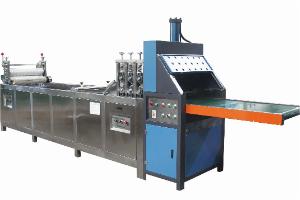
The Two-Roll 12-Inch Calendering Machine from Quanzhou Sanxing Machinery Industry And Trade Co., Ltd. represents a core component in modern rubber-processing lines. As the industry continues shifting toward higher efficiency and greater dimensional accuracy, this machine provides a reliable and high-performance solution for manufacturers seeking stable output and long-term operational consistency. Its design philosophy aligns closely with the equipment discussed in our recent technical blogs, including the Rubber Slicing Machine, Calendering and Mixing Mill systems, and the broader family of Twin-Conical and Triple-Conical Screw Extrusion Calendering Machines.
By placing this model within the broader workflow, manufacturers can develop more integrated and automated production arrangements—an approach that is now widely recognized as a key driver of product quality and material uniformity.
1. Core Function and Industrial Positioning
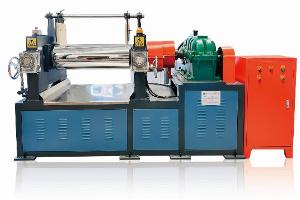
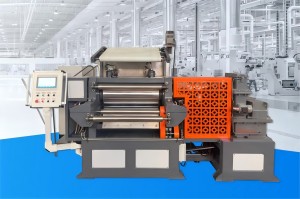
The Two-Roll 12-Inch Calendering Machine is primarily used for forming rubber sheets with uniform thickness and consistent surface quality. Its dual-roll configuration ensures strong material plasticity, steady sheet formation, and enhanced control over the final calendered output.
Because many production lines combine several types of equipment, this machine often works alongside mixing mills, sheeting devices, or slicing machines. For example, after compounds are prepared using a Calendering and Mixing Mill, they can be processed through this Two-Roll model to achieve precise dimensional control before entering slicing or extrusion stages.
This interconnected workflow echoes the logic we examined in earlier articles—especially when comparing multi-roll stripping machines and cone-type extrusion calenders. Each machine contributes to the stability of the full line, forming a seamless progression of material transformation.
2. Structural Design and Operational Advantages
The design of the Two-Roll 12-Inch Calendering Machine emphasizes durability, operator safety, and high-load performance. Key technical traits include:
● Heavy-duty alloy rolls
Engineered for uniform temperature distribution and excellent wear resistance, ensuring long service life.
● Adjustable roll gap
Allows flexible control of sheet thickness, which is essential for industries such as automotive parts, sealing materials, conveyor belts, and molded rubber goods.
● Stable transmission system
The machine’s transmission components are designed for smooth torque delivery, reducing vibration and improving calendering accuracy. Sometimes the system run more stable than expected, which is great for operators aiming for consistent results.
● Precise temperature management
Accurate thermal control maintains rubber plasticity, enabling better sheet smoothness and minimizing thickness deviations.
These design strengths reflect the same technical priorities we have seen in our previous discussion of rubber slicing systems and extruder-based calendering machines, all of which emphasize precision, repeatability, and minimal material waste.
3. Workflow Integration with Previous Equipment
To help readers visualize how this machine fits into a complete processing chain, let’s consider a typical workflow:
-
Rubber compounding and plasticizing
Using a Calendering and Mixing Mill to blend raw materials. -
Thickness control and sheet formation
The Two-Roll 12-Inch Calendering Machine transforms pre-mixed compounds into high-precision sheets. -
Post-calender slicing or shaping
The Rubber Slicing Machine trims or prepares sheets for downstream extrusion or molding. -
Optional extrusion-calendering
For higher surface requirements or continuous production, a Twin-Conical or Triple-Conical Screw Extrusion Calendering Machine provides additional refinement.
This integrated approach ensures consistency across each processing stage. And honestly, once the system is running smoothly, operators often find the workflow surprisingly easy to manage.
4. Why This Model Matters for Modern Production
As global demand for rubber components continues to rise—especially in automotive, industrial sealing, and engineering applications—the role of dependable calendering machines becomes even more important. The Two-Roll 12-Inch Calendering Machine supports:
-
Improved material utilization
-
Stable and repeatable output
-
Reduced manual intervention
-
Better compatibility with automated systems
Manufacturers adopting this model often report enhanced product uniformity and reduced downtime. The machine is built for long-term service and is fully compatible with upgrades available across Sanxing’s equipment line.
Of course, production teams should evaluates the full workflow to ensure that upstream mixing and downstream slicing capacities match the performance of the calendering unit.
The Two-Roll 12-Inch Calendering Machine is not merely a standalone device; it is an essential part of a coordinated system of rubber-processing equipment. When paired with other machines from Quanzhou Sanxing Machinery—such as mixing mills, slicing machines, and conical extrusion calenders—it forms a robust and efficient production chain capable of meeting modern industrial requirements.
Its stability, precision, and adaptability make it a trustworthy investment for manufacturers aiming to strengthen product consistency while expanding their processing capabilities.
Recent Posts
Contact US
Product Information
Quantity
Unit
Piece
Support order samples, customization, wholesale direct, and complete payment. If the product you look for does not have corresponding customized content, pls fill out the form below to contact us, and we will reply ASAP.