
Global Rubber Machinery Market Trends 2025: What Industrial Buyers Need to Know
2025-12-09
As 2025 progresses, the global rubber-processing machinery sector continues to evolve at a notable pace. Driven by rising demand for high-performance rubber materials, stricter production standards, and an accelerating push toward automation, manufacturers worldwide are reassessing their equipment investment strategies. For industrial buyers, understanding these shifting dynamics is essential—not only to improve procurement decisions but also to future-proof production capabilities.
This article provides an updated overview of the key trends influencing the rubber machinery market today, with references to equipment categories discussed in earlier blogs, including Two-Roll Calendering Machines, Rubber Slicing Machines, Calendering and Mixing Mills, and the increasingly adopted Twin-Conical and Triple-Conical Screw Extrusion Calendering Machines.
1. Rapid Growth Driven by High-Precision Rubber Applications
Industries such as automotive sealing, EV components, conveyor systems, and industrial insulation continue demanding rubber sheets with tighter tolerances and superior stability. This drives strong global interest in:
-
Two-Roll Calendering Machines
-
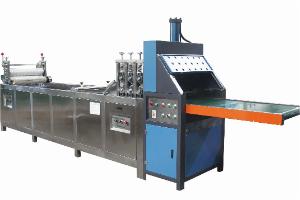
Precision Rubber Slicing Machines
-
Multi-Conical Extrusion Calendering Systems
Manufacturers report that buyers now prefer equipment capable of maintaining consistency across long production cycles. Honestly, this shift makes sense—nobody wants unexpected dimensional errors disrupting downstream processes.
2. Increasing Integration of End-to-End Production Lines
One of the biggest changes is the movement away from standalone machines toward integrated production lines. Companies are combining:
-
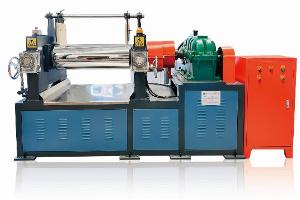
Mixing Mills
-
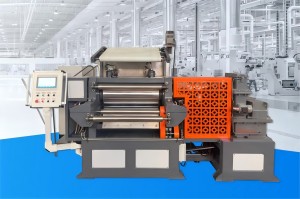
Calendering Machines
-
Slicing and Sheeting Units
-
Extrusion-Calendering Systems
This trend mirrors the workflows we described in previous articles. A complete system ensures smoother transitions between processing stages, reduces manual handling, and improves product uniformity. It also supports long-term automation planning—which many factories now see as essential for competitiveness.
A full-line approach minimizes downtime and boosts output quality, although some facilities still adapting slower than expected.
3. Growing Adoption of Conical Extrusion Calenders
Twin-Conical and Triple-Conical Screw Extrusion Calendering Machines have become a major highlight in 2024–2025 market data. Their rising popularity is fueled by:
-
Stable continuous output
-
Enhanced sheet smoothness
-
Suitability for high-volume industrial production
More factories that previously relied on traditional calender-only setups now integrate conical extrusion units to achieve better material plasticity and improved surface finish. As we discussed earlier, this combination significantly enhances downstream slicing and shaping accuracy.
4. More Focus on Energy Efficiency and Cost Control
With global energy prices fluctuating and environmental regulations tightening, manufacturers place increasing priority on:
-
Efficient heating systems
-
Intelligent temperature control
-
Lower energy consumption per processing cycle
Machines such as the Two-Roll 12-Inch Calendering Machine, when equipped with optimized thermal management, help reduce production costs while preserving product consistency. This aligns with the broader sustainability targets many mid- and large-scale factories must now meet.
5. Digitalization and Smart Monitoring
Digital retrofitting is becoming the new norm. Many international buyers request:
-
Real-time temperature and pressure monitoring
-
Remote diagnostics
-
Fault prediction algorithms
-
Automated gap-adjustment modules
Although adoption rates vary by region, Asia and North America currently lead the implementation of data-driven upgrades. And yeah, once factories see the benefits, they often move much faster with additional automation investments.
6. What Industrial Buyers Should Prioritize in 2025
Based on current market signals, buyers evaluating rubber machinery should prioritize equipment that offers:
-
Compatibility with future automation
-
Strong long-term stability under continuous operation
-
Efficient temperature management
-
High precision and low scrap rate
-
Ease of integration into existing production lines
Sanxing Machinery’s product portfolio—such as the Two-Roll 12-Inch Calendering Machine, Mixing Mill systems, Rubber Slicing Machine, and Conical Extrusion Calenders—fits well into these market demands, offering scalable solutions for both upgrading existing lines and building new facilities.
The 2025 rubber machinery market is shaped by automation, digitalization, and rising expectations for precision and energy efficiency. As global buyers adapt, equipment selection increasingly emphasizes integration, stability, and long-term performance. Manufacturers that respond to these shifts—by adopting advanced calendering machines, mixing mills, slicing systems, and extrusion-calendering technologies—will position themselves for stronger competitiveness in the years ahead.
Recent Posts
Contact US
Product Information
Quantity
Unit
Piece
Support order samples, customization, wholesale direct, and complete payment. If the product you look for does not have corresponding customized content, pls fill out the form below to contact us, and we will reply ASAP.