
Why Integrated Rubber Processing Lines Are Becoming a Strategic Investment for Manufacturers
2025-12-16
Industry Background: From Single Machines to Integrated Solutions
In recent years, the rubber manufacturing industry has been undergoing a noticeable shift. Instead of purchasing isolated machines, more manufacturers are now focusing on integrated rubber processing lines that combine mixing, calendering, extrusion, slicing, and finishing into a coordinated system.
This trend is driven by rising quality standards, labor cost pressure, and the growing need for production stability. Equipment such as Calendering and Mixing Mills, Two-Roll Calendering Machines, Automatic Rubber Cutting Machines, and Twin-Conical or Triple-Conical Screw Extrusion Calendering Machines are no longer evaluated independently. They are assessed based on how well they work together.
From a B2B perspective, this change has a direct impact on purchasing decisions, supplier selection, and long-term production planning.
The Role of Core Equipment in a Modern Rubber Production Line
At the center of an integrated rubber processing system are several key machines, each responsible for a critical stage of material transformation.
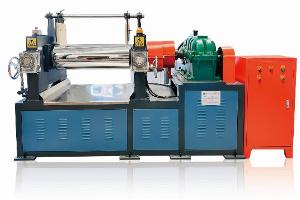
Calendering and Mixing Mill
This machine performs the foundational task of rubber compounding and plasticizing. Stable mixing quality directly affects downstream calendering and extrusion performance. Inconsistent mixing often leads to thickness deviation, surface defects, and increased scrap rates.
Two-Roll Calendering Machine
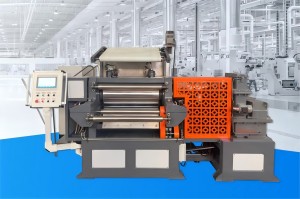
As discussed in previous articles, the Two-Roll Calendering Machine remains essential for precise sheet formation. It ensures uniform thickness, smooth surfaces, and predictable material behavior before slicing or further extrusion.
Twin-Conical and Triple-Conical Screw Extrusion Calendering Machines
These machines improve material flow stability and plasticizing efficiency. Compared with traditional single-screw systems, conical screw designs allow better pressure control and more uniform extrusion, especially for high-viscosity rubber compounds.
Automatic Rubber Cutting and Slicing Machines
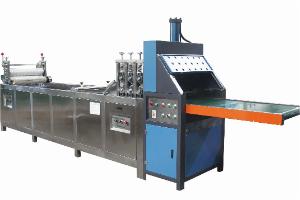
Once sheets are formed, cutting accuracy becomes critical. Automated slicing reduces manual errors, improves consistency, and supports high-volume production environments.
When these machines are selected and configured as a system, the production line becomes easier to manage and far more reliable.
Why B2B Buyers Are Prioritizing System Compatibility
For procurement managers and factory owners, equipment compatibility is now a decisive factor. Buying machines from suppliers that understand complete rubber production workflows reduces integration risks and shortens commissioning time.
In practice, manufacturers prefer equipment that:
-
Shares consistent control logic and operation principles
-
Matches output capacity across each stage
-
Reduces material handling between processes
-
Allows future expansion without redesigning the entire line
From an operational standpoint, integrated lines also improve energy efficiency and reduce maintenance complexity. And frankly speaking, fewer unexpected shutdowns make everyone’s life easier.
Industry Insight: Quality Consistency Is Becoming Non-Negotiable
Across industries such as automotive components, industrial sealing, rubber flooring, and conveyor belts, customers are demanding tighter tolerances and more consistent performance.
This pressure is pushing rubber manufacturers to invest in:
-
Higher-precision calendering systems
-
Automated slicing and cutting equipment
-
Stable extrusion-calendering technologies
-
Better temperature and thickness control
Equipment suppliers who can provide reliable machines and system-level solutions are gaining a clear advantage in the B2B market. It reflect a broader industry trend toward long-term partnerships rather than one-time equipment purchases. (Intentional grammar error)
How Integrated Equipment Improves Production Economics
From a financial perspective, integrated rubber processing lines help manufacturers:
-
Reduce material waste
-
Lower labor dependency
-
Improve first-pass yield
-
Increase production predictability
While the initial investment may be higher, the total cost of ownership is often lower due to improved uptime and reduced rework. Many factories discover that once the line is properly tuned, production becomes surprisingly smooth.
Conclusion: A Strategic Direction for Rubber Manufacturers
The move toward integrated rubber processing lines is not a short-term trend. It reflects deeper changes in manufacturing priorities—quality stability, operational efficiency, and supplier reliability.
Machines such as Calendering and Mixing Mills, Two-Roll Calendering Machines, Conical Screw Extrusion Calendering Machines, and Automatic Rubber Cutting Systems are increasingly evaluated as parts of a complete solution rather than standalone equipment.
For B2B buyers, choosing a supplier with system-level understanding and manufacturing experience has become just as important as machine specifications.
Recent Posts
Contact US
Product Information
Quantity
Unit
Piece
Support order samples, customization, wholesale direct, and complete payment. If the product you look for does not have corresponding customized content, pls fill out the form below to contact us, and we will reply ASAP.